
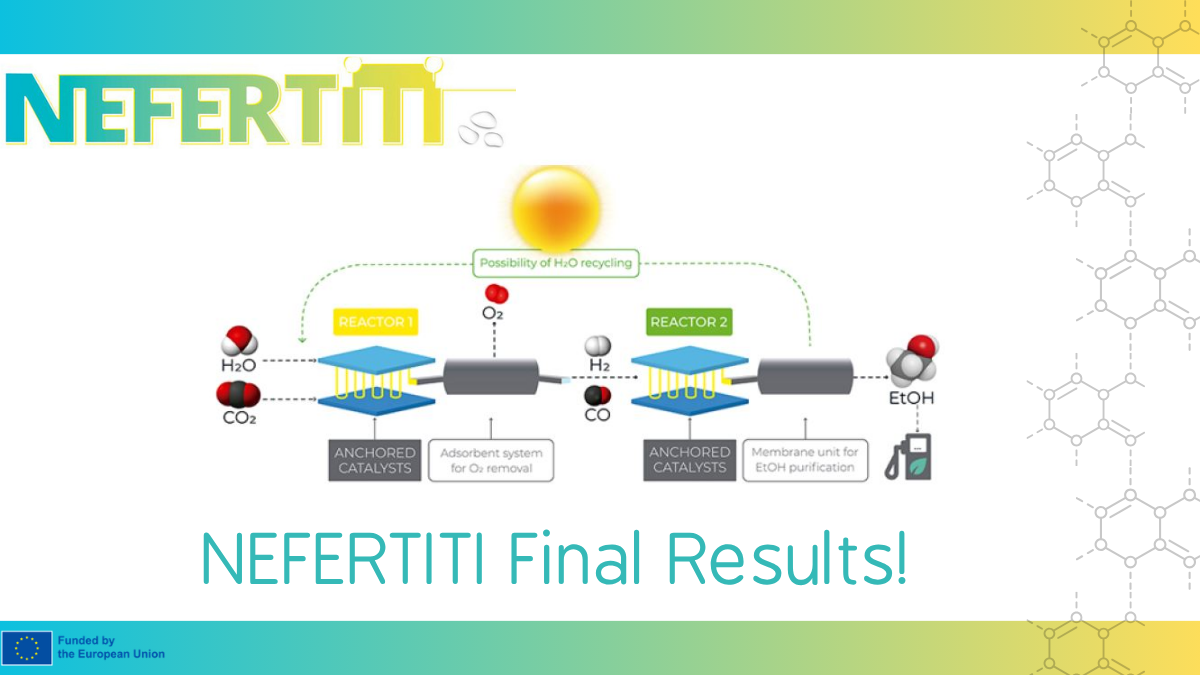

As NEFERTITI reaches its conclusion, the project leaves
behind a significant legacy of scientific, technological and business-oriented
results that contribute to the advancement of sustainable carbon capture and
utilisation technologies.
Throughout its duration, the consortium developed innovative
solutions addressing key challenges in CO₂ conversion, renewable energy
integration, catalyst development and process sustainability.
· Advancing Solar-Powered CO₂ Conversion Technologies
Among the most significant achievements of NEFERTITI are
several innovative technologies designed to improve the efficiency and
sustainability of carbon dioxide conversion processes.
LEITAT developed a series of breakthrough solutions,
including novel integrated flow reactors that enable sunlight-catalysed
reactions at substantially lower temperatures compared to conventional thermal
processes. These reactors demonstrate enhanced selectivity towards valuable C₂+
alcohols, opening new opportunities for sustainable chemical production.
In addition, LEITAT developed a membrane separation unit for
ethanol purification through pervaporation, offering improved separation
performance beyond conventional vapor-liquid equilibrium limitations. The
partner also advanced luminescent solar concentrator coatings capable of
enhancing solar conversion efficiency while relying on non-toxic materials.
Further strengthening the project's technological portfolio,
CHEMTRIX developed a new flow reactor and light source specifically designed
for photochemical flow reactions, featuring efficient light coupling enabled
through innovative reactor design and luminescent solar concentrator
integration.
·
Innovative Catalysts and Materials for Carbon
Valorisation
The project generated significant advances in catalyst
design and photocatalytic materials for CO₂ reduction.
Peking University (PKU) developed a photocatalytic flow
reactor (PCFR2) for alcohol generation, integrating advanced catalyst design
methodologies with efficient reactor engineering to support the conversion of
carbon dioxide into valuable chemical products.
The University of Galway contributed novel hybrid materials
for CO₂ reduction, expanding the scientific foundation for future developments
in carbon valorisation technologies.
ICIQ developed new molecular solar concentrators with
enhanced light absorption and emission properties, representing a promising
step toward more efficient solar-driven chemical processes.
FUNDITEC further strengthened the project's technological
capabilities through the development of advanced know-how in catalyst
immobilisation and scale-up strategies for both COF-based and metal-based
photocatalysts. These developments support improved catalyst stability,
durability and compatibility with continuous-flow reactor systems.
·
Expanding Scientific Knowledge and
Sustainability Assessment
Beyond technological developments, NEFERTITI has generated
substantial scientific knowledge that will continue supporting future research
and innovation.
The University of Burgos (UBU) expanded theoretical
understanding in several critical areas, including catalyst design for
simultaneous CO₂ reduction and water oxidation, syngas transformation into
ethanol and higher alcohols, integrated sustainability assessment of materials
and processes, and the evaluation of human and environmental safety aspects
associated with emerging carbon conversion technologies.
These results provide valuable scientific foundations for
future research initiatives and contribute to the broader European effort
towards climate-neutral industrial processes.
·
Expanding Scientific Knowledge and
Sustainability Assessment
Several project results are positioned for future commercial
exploitation.
SOCAR developed valuable know-how in solar-powered carbon
capture technologies, flue gas purification and conversion processes, supported
by operationally flexible system designs with potential future spin-off
opportunities.
STRATAGEM contributed to the development of innovative
business models and exploitation frameworks tailored to early-stage CO₂
valorisation technologies. This work supports the transition of research
results from laboratory environments towards market adoption and industrial
implementation.
By bringing together expertise in catalysis, photochemistry,
reactor engineering, sustainability assessment and business innovation,
NEFERTITI has established a strong foundation for future advancements in carbon
capture and utilisation technologies.
The project's results demonstrate how interdisciplinary collaboration can accelerate the development of sustainable solutions for carbon valorisation, supporting Europe's transition towards a climate-neutral and circular economy.